March 21, 2023
AXA Foresight Report 2023: Risk - A Mosaic of Perceptions
Explore people’s perceptions of risks in a world of crisis
4 minutes

Marie Bogataj
AXA Research Fund & Group Foresight Director
Risk is becoming an increasingly complex notion with multifaceted effects. Its changing nature prompts questions about subjective risk perceptionby different social groups or individuals and how these perceptions might evolve in the future. By addressing the issue of risk perception this report sheds a new light on the sense of vulnerability across groups and geographies and informs the relevant types of protection and solutions that could be put in place in the future.
The individual perspective
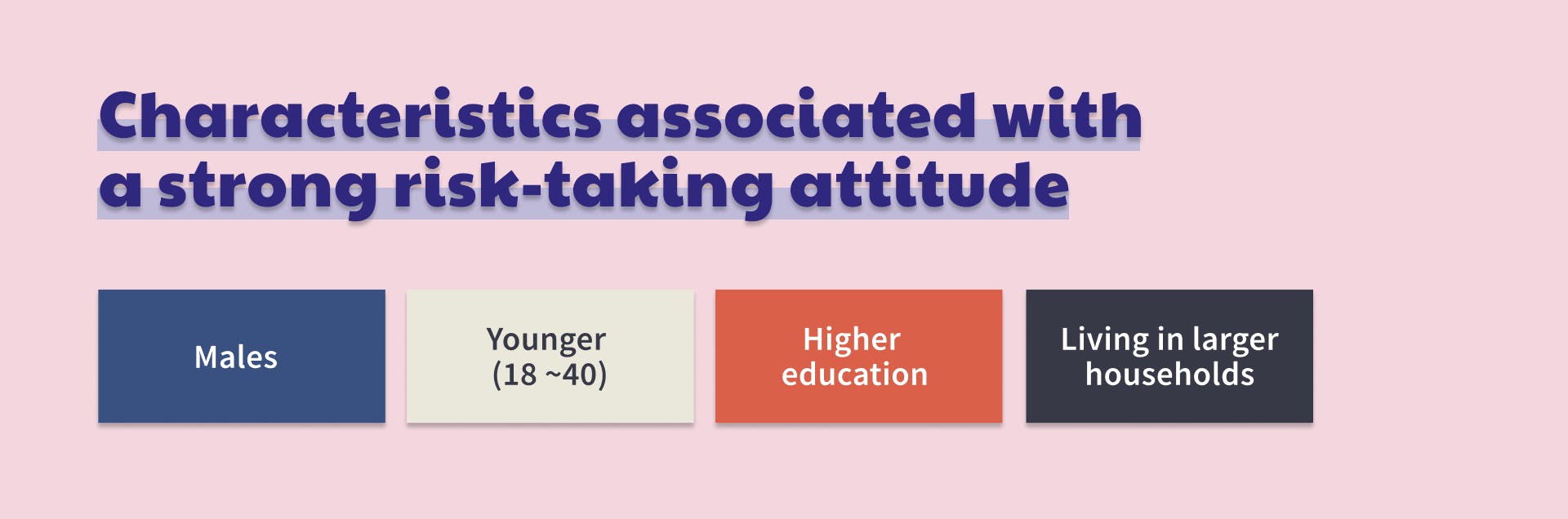
Adopting a sociological perspective, our exploration starts with mapping risk perception at the individual level. Grounded from the Future Risk Survey by IPSOS, encompassing 19,000 respondents from the general population across 15 countries, the data reveals that a strong risk-taking attitude is positively associated with being a male, at young and middle-age (18 to 40 years old), receiving a higher income and higher education, living in larger households, and having children. In terms of perceived vulnerability, women and socially disadvantaged groups (population with lowerincome and education) tend to have a higher sense of vulnerability in everyday life.
The geographical perspective
The global trend between risk-taking and socio-demographic characteristics may vary from country to country, where there are also contrasting patterns in the feeling of vulnerability.
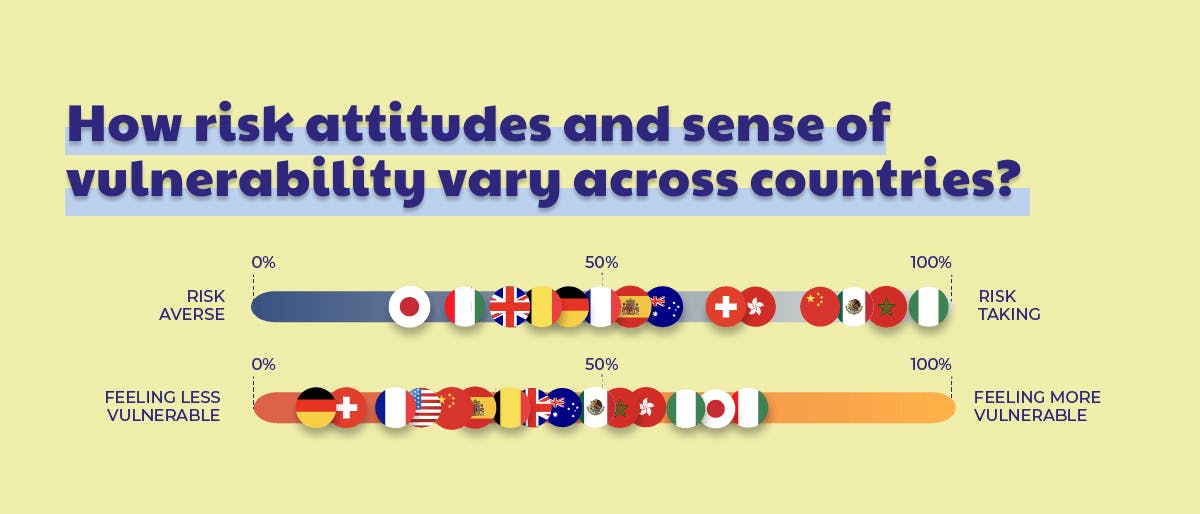
Based on analysis by a research team at Ecole NormaleSupérieure specialized in the Geopolitics of Risk, the report also provides a comparative analysis of differences in perception of major risks (e.g.: climate, energy, geopolitics) according to country and region. Itshows that concerns around a single topic can differ in neighboring countries or in different age groups.
The foresight perspective: Fear or not to fear
With contributions from our editorial partner Usbek et Rica, a French foresight magazine that explores the future, the report proposes three forward-looking scenarios on the stakeholder people trust in the future discussing therole of technology, communities, and trust third parties (e.g. public and private organizations)to provide protection.
As risks continue to evolve, so will the way society approaches and confronts them. Starting from the findings highlighted in this document, we imagined a few fictional scenes questioning how we’ll deal with risks in the decades to come.
Jump into our time machine and enjoy the ride!





The AXA Foresight Report 2023 shows that risk is never perceived the same way twice: it is shaped by who you are, where you live, and what you've lived through, which means protection strategies must be as locally grounded as the risks themselves.
It reveals that risk is never perceived the same way twice: based on a survey of 19,000 people across 15 countries, it shows how age, gender, income and culture lead people to prioritize risks very differently - and concludes with three scenarios for where societies will place there trust for protection by 2050.
FAQ
What is the AXA Foresight Report?
The AXA Foresight Report is AXA's annual publication exploring long-term risks and societal transformations relevant to insurance, combining expert analysis, data, and scenario-based foresight methods.
Who produces the AXA Foresight Report, and how often is it published?
The AXA Foresight Report is produced annually by the AXA Group Foresight Team, in partnership with external experts and research institutions, in a series published every year since 2019.
How do people in different countries perceive the same risks, and what does this tell us?
The AXA Foresight Report 2023 shows that risk perception is socially constructed: historical, cultural and political contexts lead people in each country to prioritize risks differently (for example, pollution and geopolitical tensions rank higher in France and China than in the UK or Japan), highlighting that global risks must be understood and addressed through locally grounded perspectives.
How do demographic factors like age, gender, and income influence how people assess risk?
Across 19,000 respondents in 15 countries surveyed for the AXA Foresight Report 2023: 64% of men identify as risk-takers versus 51% of women (20% of men call themselves "strong risk-takers" versus 13% of women). Willingness to take risks gradually declines between ages 35 and 65; income matters too, with 23% of high-income respondents calling themselves strong risk-takers versus 14% in middle/low-income groups.
How might people build trust in protection against risks by 2050?
The AXA Foresight Report 2023 explores three speculative scenarios for 2050, each centered on a different "lever" of trust: one where confidence comes mainly from pervasive technologies (AI, connected devices, blockchain-based smart contracts), another where it is delegated to powerful third parties (states and large corporations under tighter regulation), and a third where trust is rooted in local communities in a more frugal, low-tech society relying on mutual aid and cooperatives.
How does the constructivist approach used in the 2023 AXA Foresight Report change the way we understand risk perception?
According to J. Peter Burgess, AXA Chair in the Geopolitics of Risk at École Normale Supérieure, the AXA Foresight Report 2023 uses a constructivist approach that sees risk assessment and management as shaped by individual and collective values rather than as purely objective facts. This reveals why the same risk can be perceived very differently across social groups and cultures.
Do older generations really feel more vulnerable to everyday risks than young people?
Survey data from the AXA Foresight Report 2023 show that people over 65 feel least vulnerable in their daily lives, while under-25s report the highest sense of vulnerability. Only 4% of respondents fully agree with the statement "In my everyday life, I often feel vulnerable," and this perception is concentrated among the youngest age group rather than seniors.
Why does this still matter?
The report's central finding (that trust and risk perception vary sharply by income and geography) has deepened rather than faded. The 2026 Edelman Trust Barometer found that the trust gap between high- and low-income respondents has more than doubled since 2012, and found society retreating into "insularity," with seven in ten people now unwilling or hesitant to trust someone with different values or backgrounds. Source: Edelman, 2026 Edelman Trust Barometer (Jan 18, 2026)