AI: turning uncertainty into responsible opportunity
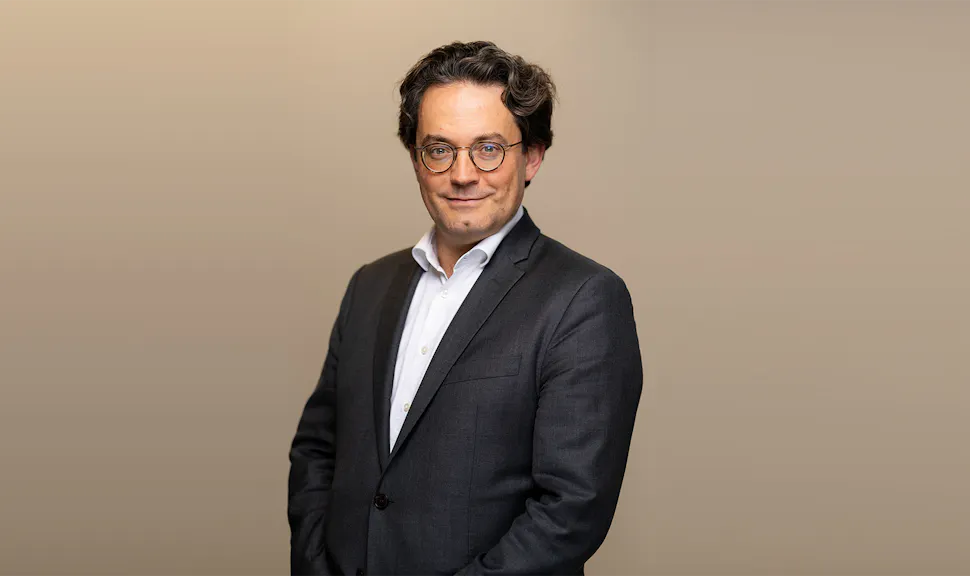
Matthieu Caillat, Group Chief Technology & AI Officer, Chief Executive Officer of AXA Group Operations, shares how AXA is embracing AI responsibly while keeping people at the heart of innovation.
3 minutes
How is AXA harnessing the opportunities offered by AI while ensuring it is used responsibly?
AI represents a significant opportunity to improve our services and better support our customers in a world where risks are changing rapidly. It is also a powerful lever for greater operational efficiency, enabling our employees to focus on higher-value activities. At AXA, that potential is already very tangible: we estimate that AI can help us make better use of 3.5 billion unstructured documents, whether by extracting useful information, routing a case to the right expert, or speeding up its processing.
This transformation is also visible across our businesses. With SmartInAXA, for example, AXA France sales teams can access product knowledge and receive a reasoned answer in natural language within seconds. The tool already supports more than 19,000 users across personal property and casualty insurance and handles around 1,500 requests a day. The aim is not to replace the expertise of our advisers, but to give them more time to listen to customers and provide personalised support.
But this transformation can only be sustainable if it is built on trust. That is why we govern the entire lifecycle of our AI solutions: validating use cases, ensuring data quality and security, and selecting the most appropriate models in terms of security, transparency and environmental impact. We also ensure that the most sensitive decisions remain under human oversight.
Ultimately, our view is simple: artificial intelligence does not replace human judgement; it augments it. Technology should enable our employees to work faster and with greater precision, while preserving what truly makes the difference in insurance: expertise, empathy and a sense of responsibility.
This year, AI has overtaken climate change as the number one risk among the experts surveyed in the 2026 Future Risks Report. Why do you think this shift has occurred, and in what ways is AI becoming a structural risk for AXA and for the economy as a whole?
AI is therefore profoundly transforming businesses, economies and the very nature of certain risks, all at the same time. As an insurer, our role is to understand emerging risks, anticipate them and help our customers manage their consequences. Our responsibility is to help create the conditions for the controlled development of this technology, so that we can serve our customers better while continuing to protect them.
First and foremost, this shift reflects the speed at which artificial intelligence has spread throughout the economy and into our everyday lives. In just a few years, it has moved from being an emerging technology to a widely accessible tool, capable of influencing decisions, operational processes and interactions with customers.
This acceleration is creating risks on a new scale. AI can amplify cyberattacks and disinformation, reproduce bias at scale, or create new technological dependencies. It also raises complex questions around transparency and accountability when an automated system makes a recommendation or contributes to a decision. In several areas, uses of AI are now evolving faster than governance and regulatory frameworks.
Our collective responsibility is to support both our customers and our employees as they adopt this new technology, ensuring that it is used responsibly and safely, and above all creating the conditions to keep people at the heart of every strategic decision.
How does the AXA Group intend to continue developing AI as part of its technology strategy and risk management, and now through its new strategic plan, ‘Growing Forward’?
At AXA, we believe that managing the risks associated with emerging technologies and harnessing the innovation enabled by artificial intelligence must go hand in hand. This is particularly important for AI, given the speed of its development and the breadth of its applications.
Our approach starts with a clear governance framework. We set the conditions for using AI, safeguard data quality and system security, and aim to ensure the right level of transparency for each use case. Human oversight remains essential, especially for the most sensitive decisions. This framework is not designed to slow innovation down, but to enable it to be deployed responsibly and sustainably.
This approach is fully aligned with the ambitions of our 2027-2029 strategic plan, ‘Growing Forward’. AI should help us serve our customers better, simplify the way we operate and accelerate our transformation. But our conviction remains unchanged: technology must remain at the service of people, trust and protection.